

OptiViVax Study Presented at American Society of Tropical Medicine and Hygiene Annual Meeting 2025
OptiViVax Study Presented at American Society of Tropical Medicine and Hygiene Annual Meeting 2025
Researchers report preliminary results of the BIO-006 study, a collaboration between Radboud University Medical Centre and the University of Oxford, demonstrating the feasibility of a relapsing Plasmodium vivax Controlled Human Malaria Infection (CHMI) model
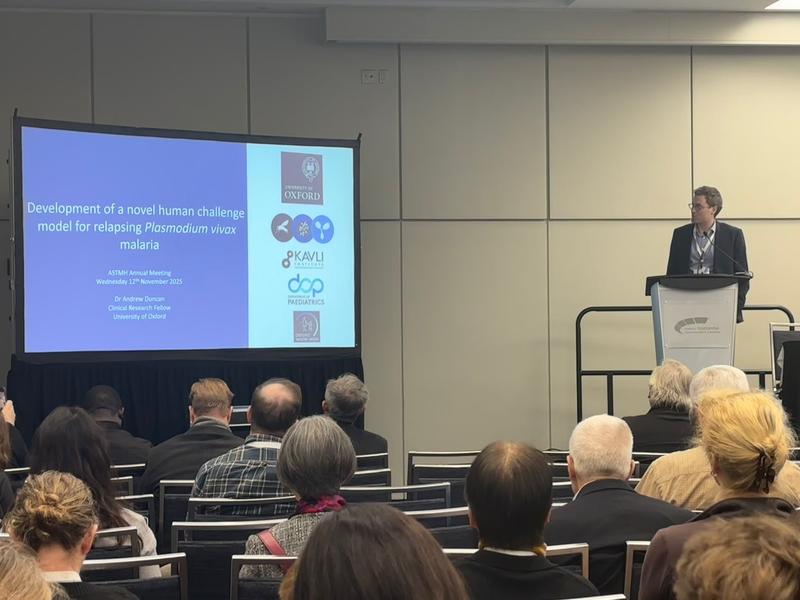
Plasmodium vivax presents unique challenges to malaria treatment and prevention efforts due to its ability to cause relapse infections. As well as a source of symptomatic disease, dormant forms of the parasite called hypnozoites (which can reactivate weeks or months after initial infection) act as an important reservoir of infection and contribute significantly to P. vivax transmission. Addressing the public health burden of P. vivax malaria therefore requires substantial improvements in our understanding relapse infections, and the development of tools and methods that allow new interventions to be assessed for efficacy.
In the BIO-006 study, five healthy volunteers were deliberately infected with Plasmodium vivax administered by mosquito bite. This “Controlled Human Malaria Infection” (CHMI) allowed researchers to carefully administer P. vivax infection and safely monitor participants for relapse infections. All participants experienced at least one relapse infection during the 6 month follow up period before undergoing definitive anti-relapse malaria treatment, marking a real success for this proof-of-concept study. The BIO-006 study has demonstrated the feasibility of a relapsing P. vivax CHMI model as a potential platform for testing novel vaccine candidates, and has provided researchers with an opportunity to improve our understanding of relapsing P. vivax malaria. The study and analyses are ongoing.
We are very grateful to the participants and study teams involved as we take a step forward in combatting relapsing P. vivax malaria.

